Student Loan Debt: Your Complete Resource
Federal student loans are changing faster than they have in decades. New repayment plans, new borrowing limits, and shifting forgiveness rules mean the right move for your loans may look different than it did a year ago. Whether you have federal loans, private loans, or both, we’ll help you lower your payments, find forgiveness, and build a plan to become debt free.
Data as of March 31, 2026. See our full student loan debt statistics.
Want Help Staying On Top Of Your Student Loans?
Join our student loan list. We’ll email you when the rules change and what to do about it.
Where Are You Right Now?
Jump to what you need
Student Loan Debt By The Numbers
Our most-cited data
The median is well below the average because income-driven plans tie many borrowers’ payments to their income. See the full repayment data.
Need To Find Your Loans?Complete List Of Federal Student Loan ServicersStudent Loan Debt Collectors And How To Contact ThemFull List Of Student Loan Lenders
Paying For College
Before you borrow
The best way to lower your student loan debt is to borrow less in the first place. That means lowering your cost of attendance, getting every dollar of free aid you qualify for, and borrowing smart when you do need loans. College is an investment of time and money, and it only pays off if your future earnings outweigh what you spend.
Major ChangesFor loans first disbursed on or after July 1, 2026, Grad PLUS loans are closed to new borrowers and Parent PLUS loans have new annual and lifetime caps. Many families will need to plan for a bigger gap between aid and cost.
Saving For College
Financial Aid
Borrowing
- Best Student Loans And Current Rates
- Best Private Student Loan Lenders
- State-Based Non-Profit Lenders
- Is $5,500 Really All My Kid Can Borrow?
- What To Do If You’re Denied A Parent PLUS Loan
- Student Loans For Community College
- International Student Loans
- Best Income Share Agreements
- Quick Student Loans At The Last Minute
Graduate And Professional School
Navigating Repayment
Pick the right plan
Navigating repayment means finding the plan that fits both your income and your goal, whether that’s maximizing forgiveness or paying your loans off as fast as possible. The federal options changed on July 1, 2026, when the new Repayment Assistance Plan (RAP) launched. New loans can only use RAP or a standard plan, and older plans like SAVE, PAYE, and ICR are being phased out.
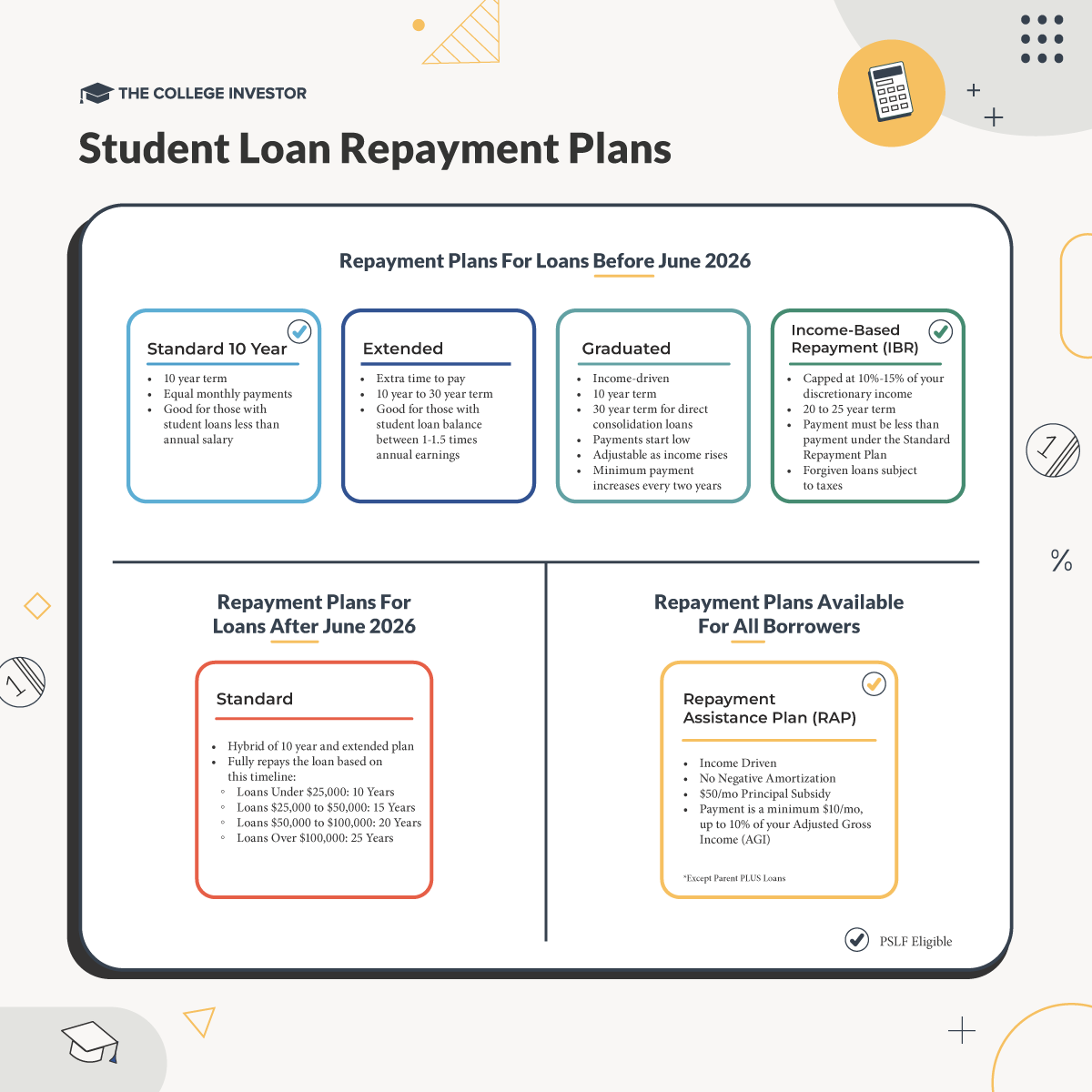
- If you qualify for Public Service Loan Forgiveness or another broad forgiveness program, keep your payment as low as possible.
- If you owe more than your annual salary, a lower income-driven payment usually makes sense, even without PSLF.
- If you owe less than your salary and don’t qualify for forgiveness, pay your loans off as fast as you can.
Student Loan Forgiveness
Find every program you qualify for
We estimate that about half of all borrowers qualify for some type of full or partial student loan forgiveness. Most programs are based on your repayment plan or your job, but some state programs reward things like working in a rural area or buying a home in the state. The most popular program, Public Service Loan Forgiveness, requires 10 years of qualifying payments while working for a qualifying employer.
Behind On Payments Or In Default
There’s a way back
More than 9 million federal borrowers are in default, and defaulted federal loans can be collected through wage garnishment and tax refund offsets without a court order. If you’re behind, act before your loans default. If you’re already in default, rehabilitation or consolidation can get you back to good standing.
Student Loan Refinancing
Lower your rate
Refinancing replaces your existing loans, federal or private, with a new private loan. Consolidation replaces federal loans with a new federal loan, and it’s free. Refinancing can make sense if you already have private loans and can get a lower rate. It can also make sense for federal loans if you’ll pay them off quickly and won’t qualify for forgiveness, which is why many doctors refinance. Once you refinance federal loans, you lose access to federal repayment plans and forgiveness for good.
Compare Student Loan Lenders
Our lender reviews, A to Z
We review as many student loan lenders as we can find. Shopping around is the best way to get a low rate. Start with our full list of student loan lenders, or read our individual reviews:
Read More Student Loan Content
We’ve published hundreds of articles on student loans, from repayment and forgiveness to private lenders and taxes.
Student Loan Terms And Definitions
134 terms, A to Z
Learn what these student loan terms mean, from A to Z.
C
D
F
- FAFSA (Free Application For Federal Student Aid)
- Federal Family Education Loan Program (FFELP)
- Federal Reserve
- Federal Student Aid (FSA)
- Federal Student Loan Forgiveness
- Financial Aid
- Financial Aid Counselor
- Financial Aid Officer
- Financial Hardship
- Financial Literacy
- Fixed Interest Rate
- Fixed Rate Loan
- For-Profit College
- Forbearance
I
L
P
R
S
- Sallie Mae
- Saving On A Valuable Education (SAVE)
- Scholarship
- Scholarship Coordinator
- Securitization
- Simple Interest
- Stafford Loans
- Standard Repayment Plan
- Statute Of Limitations
- Strategic Default
- Student Aid Index (SAI)
- Student Aid Report
- Student Debt
- Student Debt Crisis
- Student Loan
- Student Loan Ombudsman
- Student Loan Trust
- StudentAid.gov
- Subsidized Loans
- Surety
T

Get the latest financial news and actionable insights.
How it works:
- 1Enter your email and subscribe.
- 2Get the latest personal finance and education news delivered every week.
- 3Take control of your finances with real insights.
- 4We won't spam you, ever!